

 Русский
 Bahasa Indonesia
 فارسی
فارسی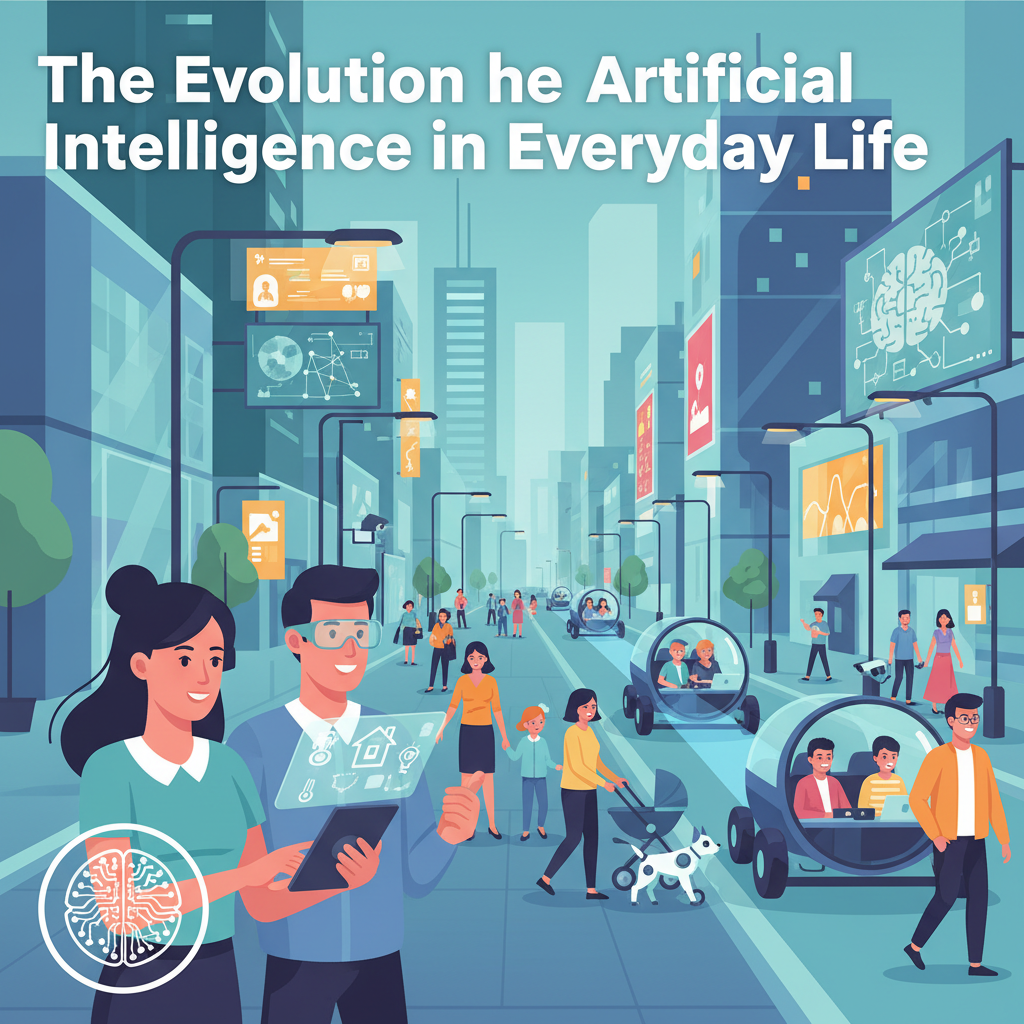
Artificial Intelligence (AI) has rapidly moved from theoretical concepts to practical applications that touch nearly every aspect of our daily lives. This article explores how AI technologies are reshaping our routines, enhancing convenience, and prompting new ethical debates. Discover the evolution, current impact, and future possibilities of AI in transforming everyday experiences.
From Concept to Reality The Growth of AI
The journey of artificial intelligence from a conceptual aspiration to a transformative technological force is rooted in decades of cumulative scientific ambition and discovery. In the mid-20th century, pioneering figures like Alan Turing posed foundational questions about machine intelligence, leading to the establishment of early theories that speculated about computers mimicking human problem-solving. The creation of the first programmable computers sparked optimism—the 1956 Dartmouth Summer Research Project is often recognized as AI’s formal birth, proposing that “every aspect of learning…can in principle be so precisely described that a machine can be made to simulate it.”
Over time, progress accelerated thanks to advances in computational power and the invention of new algorithms. Symbolic AI, which hinged on explicitly programmed rules and logic, dominated early decades. As complexity and data demands grew, researchers began exploring alternative paradigms, resulting in machine learning—a method that enables computers to learn patterns from vast datasets without explicit programming. The development of neural networks mimicked aspects of the human brain, unlocking new possibilities for learning from data.
Modern AI’s capabilities owe much to an abundance of data and innovations in data analytics, enabling unprecedented levels of pattern recognition and predictive accuracy. These steps, traced through Wikipedia’s catalog of milestones from expert systems to deep learning breakthroughs, have redefined what AI can achieve in practical, everyday scenarios.
AI in Our Homes and Devices
The foundation of artificial intelligence can be traced back to the mid-20th century when pioneers like Alan Turing posed fundamental questions about computation and intelligence. Early AI research drew upon both philosophical speculation and nascent computer science concepts. The 1956 Dartmouth Conference, considered the birth of AI as a discipline, introduced the possibility of machines simulating human intelligence. Over the following decades, progress moved in waves. The 1960s and 1970s saw the first “expert systems” that performed logical reasoning in specialized domains like medicine and mathematics. However, limited computing power and insufficient data led to stagnation, often termed the “AI winter.”
Breakthroughs emerged as computational capabilities advanced, especially with the rise of machine learning—the ability of systems to improve from experience—fueled by expanding data and more efficient algorithms. Neural networks, inspired by the structure of the human brain, became central to this surge. With the resurgence of deep learning in the 2010s, these networks could finally process immense datasets and identify intricate patterns, making technologies like image and speech recognition practical. Today, data analytics and AI are inseparable, empowering systems to interpret complex information and adapt to evolving tasks with astonishing speed and accuracy.
Artificial Intelligence at Work and in Education
In the early 20th century, the idea of artificial intelligence began as a speculative concept, shaped by philosophical debates about the nature of thinking machines. It wasn’t until the mid-1900s, with Alan Turing’s groundbreaking work, that AI entered the realm of practicality. Turing’s concept of the “universal machine,” outlined in his 1936 paper, set the theoretical foundation for computers that could simulate any process of formal reasoning. The progress accelerated in 1956, when the Dartmouth Conference formally introduced the term “artificial intelligence” and outlined ambitious research goals for computational thinking.
Throughout the following decades, AI experienced phases of optimism and challenge. Developments like perceptrons in the 1950s inspired early neural networks, though limited by hardware and theoretical constraints. Progress regained momentum in the 1980s and 1990s, as advances in computer processing and new algorithms revived neural networks in the form of deep learning. This modern AI, leveraging massive datasets, enables programs to learn and improve without explicit programming. Key breakthroughs—such as IBM’s Deep Blue defeating a chess grandmaster in 1997 and Google’s AlphaGo mastering the complex board game Go—highlight the power of machine learning, neural networks, and data analytics in enabling AI to move from theory toward everyday practicality.
AI and Society Ethical Considerations
The concept of artificial intelligence has evolved dramatically over the last century, transforming from theoretical musings into practical, ubiquitous technology. In the 1950s, pioneers such as Alan Turing and John McCarthy laid the intellectual groundwork by questioning if machines could think and by coining the term “artificial intelligence” itself. The development of the first programmable computers provided a platform for early experiments, such as Marvin Minsky’s work at MIT and the creation of rule-based systems in the 1960s. These early systems, while limited, demonstrated that machines could follow complex instructions and solve specific problems.
The 1980s saw a surge in interest with the emergence of neural networks—computer models mimicking the human brain. These networks were initially limited by processing power and data, but rapidly advanced as computing capabilities grew. The real breakthrough came in the 21st century with the expansion of machine learning and data analytics. These tools empowered AI to analyze vast datasets, recognize patterns, and learn from experience, enabling applications from speech recognition to image analysis. Thanks to these interconnected milestones—each building on advances in computational theory, hardware, and algorithmic design—AI has matured into a transformative force in our daily lives.
The Future of AI in Daily Life
The fascinating journey of artificial intelligence began in the mid-20th century, where pioneering minds like Alan Turing and John McCarthy laid the conceptual foundations. Turing’s notion of a “machine that can think” and McCarthy’s coinage of the term “artificial intelligence” ignited an intellectual revolution. The creation of early symbolic AI involved researchers programming machines to manipulate symbols and rules, simulating “intelligent” problem-solving. The 1956 Dartmouth Conference, hailed as the birthplace of AI as an academic discipline, set a trajectory that evolved through decades of innovation.
As computing power increased, so did ambitions. By the 1980s, researchers introduced *machine learning*, enabling computers to “learn” from data rather than be explicitly programmed. This leap fostered the development of *neural networks*, inspired by the human brain’s architecture, allowing machines to recognize patterns and interpret complex sensory data. The 21st century brought about *deep learning*—multi-layered neural networks powered by vast computational resources and big data. Today, *data analytics* processes immense datasets, revealing insights and patterns previously unreachable. Each technological milestone, from Logic Theorist to AlphaGo, has transformed AI from theoretical constructs into tangible, transformative agents in our daily realities.
Conclusions
AI has seamlessly become part of our daily routines, offering convenience, efficiency, and innovative solutions, while also raising vital ethical and social questions. By understanding its evolution and current applications, we can better prepare for its future impact and ensure these technologies serve humanity responsibly and wisely.