

 Русский
 Bahasa Indonesia
 فارسی
فارسی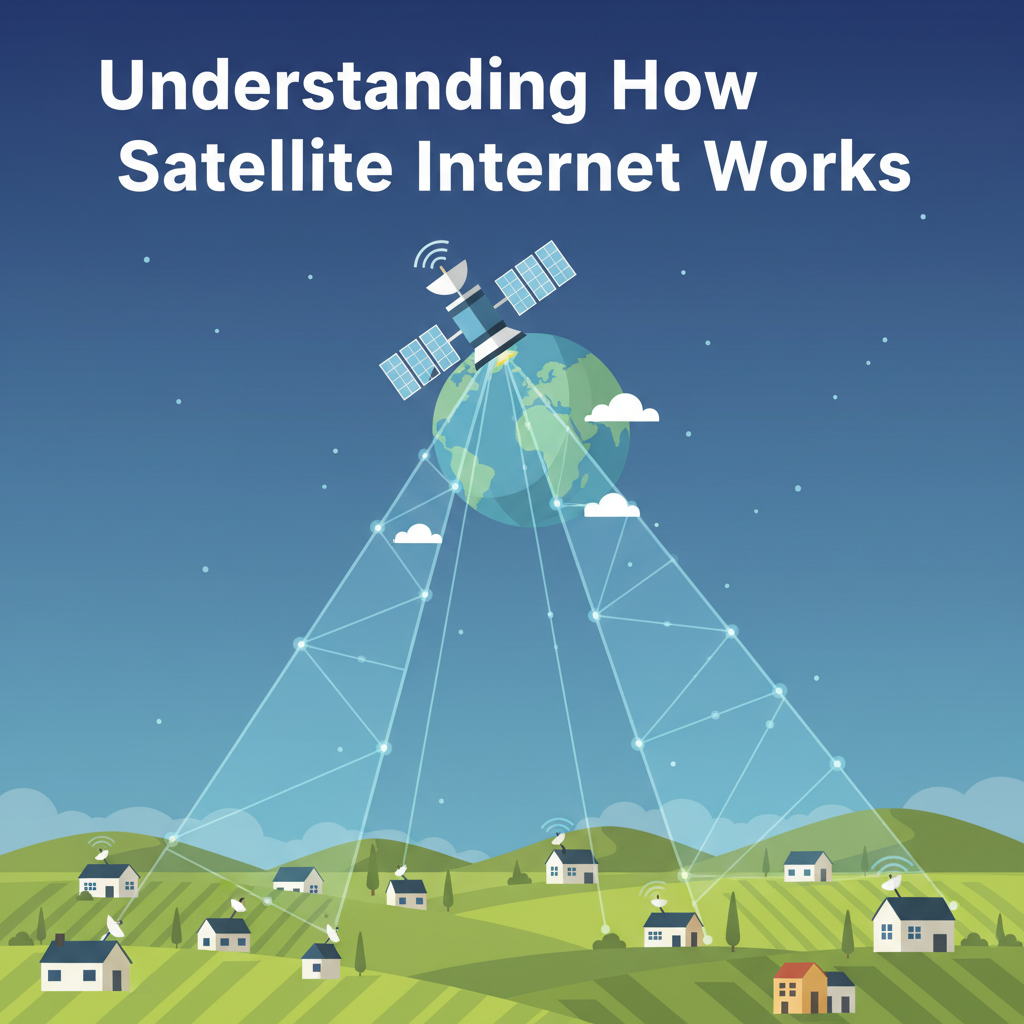
Satellite internet is a vital technology that brings connectivity to remote and underserved areas worldwide. This article explores the fundamental principles behind satellite internet, including its infrastructure, how data is transmitted, and the advantages and challenges associated with this method of delivering online access.
The Science and Technology Behind Satellite Internet
Satellite internet operates through a series of sophisticated steps and technologies that connect users in even the most remote locations to the global web. The process begins at the user’s site, where a satellite dish, precisely aligned, communicates with their modem. When a user requests data—like loading a website—the signal travels from the modem through the dish and is sent as an uplink transmission to a satellite orbiting Earth. Depending on the system, different types of satellites are used: geostationary (GEO), medium Earth orbit (MEO), and low Earth orbit (LEO). GEO satellites remain stationary 35,786 kilometers above a fixed position on the equator, providing extensive coverage but higher latency due to the long distance. MEO and LEO satellites orbit closer (ranging from about 2,000 to 20,000 kilometers for MEO and just 400 to 2,000 kilometers for LEO), which reduces latency and improves speed but often requires a constellation of moving satellites to ensure continuous coverage.
Once the signal reaches the orbiting satellite, onboard processors may route or relay the data, especially in newer LEO constellations like those deployed by SpaceX’s Starlink or OneWeb. The satellite then beams the request down to a ground station—a fixed, high-powered antenna connected to the terrestrial internet backbone. The return data follows the reverse path: ground station to satellite, then downlink from satellite to the user’s dish and modem.
Satellite internet provides global or near-global coverage, and is especially valuable in rural or underserved areas. However, it comes with challenges: latency is significant for GEO systems; atmospheric conditions such as heavy rain can cause signal degradation; and many providers enforce data caps. Major providers like HughesNet, Viasat, Starlink, and OneWeb each offer varying technologies and service characteristics. Recent advancements—like phased-array antennas and inter-satellite laser links—continue to push the boundaries of speed, reliability, and accessibility according to authoritative technical sources and Wikipedia data.
Conclusions
In summary, satellite internet operates by transmitting data between ground stations, satellites in orbit, and user terminals, enabling connectivity where traditional cables cannot reach. Despite some latency and weather-related drawbacks, it remains indispensable for bridging the digital divide and offering internet access in remote and rural locations worldwide.